Plywood, MDF or Particle Board: What to Use Where
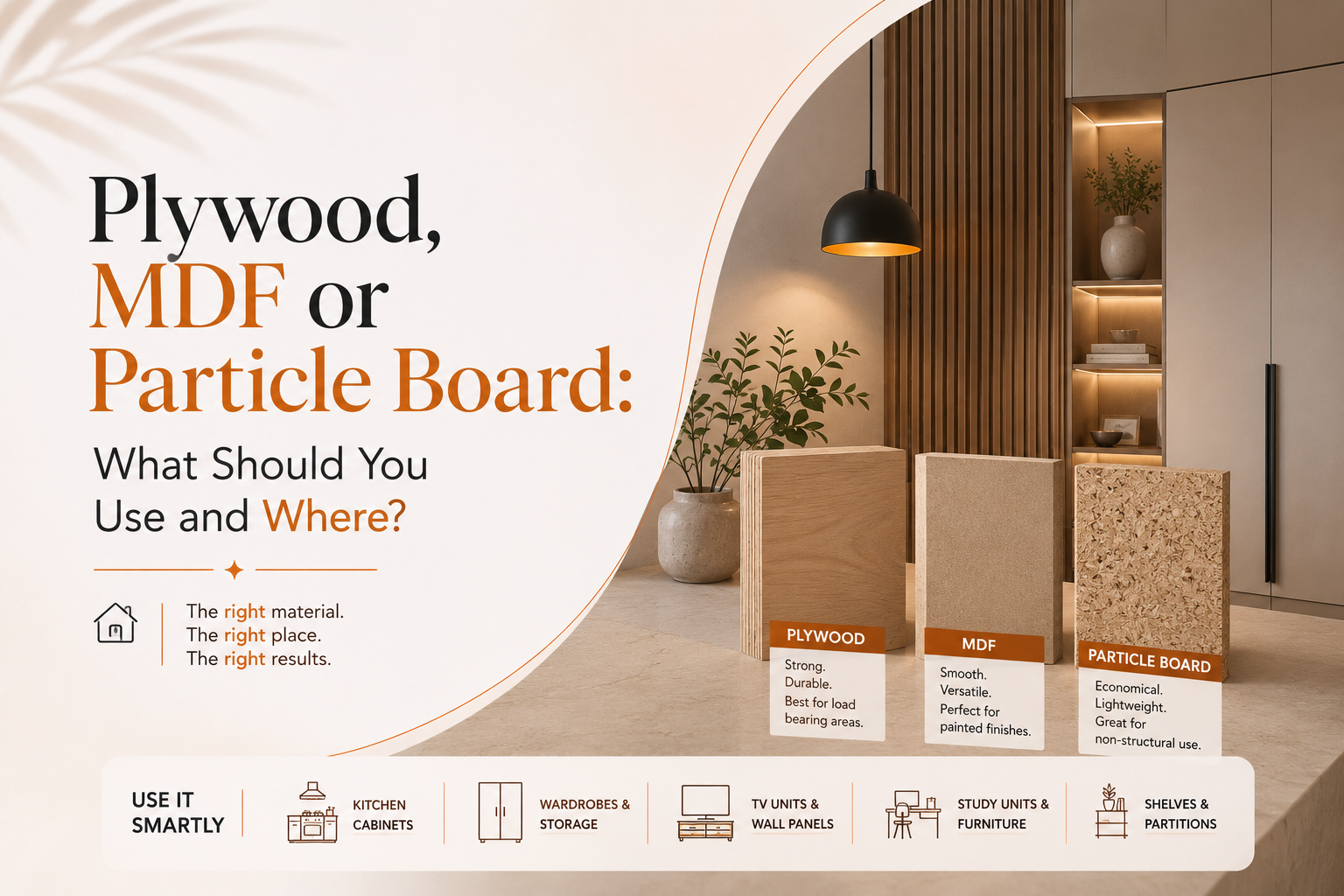
When planning home interiors, choosing colours and finishes is often the exciting part. But what lies beneath those finishes is equally important.
The core material used inside your kitchen cabinets, wardrobes, TV unit and storage furniture affects strength, durability, maintenance and cost. Three of the most commonly discussed options are plywood, MDF and particle board.
Homeowners are often told that one material is always superior to the others. In reality, each board is manufactured differently and performs best in different situations.
The right question is not, “Which material is the best?”
It is, “Which material is right for this particular application?”
Understanding the Basic Difference
Plywood, MDF and particle board are all engineered wood products, but their internal construction is different.
Plywood is made by bonding multiple thin layers of wood veneer, usually with the grain direction alternating between layers. This cross-layered construction gives plywood good strength and dimensional stability.
MDF, or medium-density fibreboard, is produced using fine wood fibres that are combined with resin and pressed into a dense, uniform panel.
Particle board is made using larger wood particles, chips and shavings that are bonded and compressed into sheets. The United States Environmental Protection Agency classifies hardwood plywood, MDF and particle board as composite wood products because they are manufactured by combining wood elements with adhesives.
Because their internal structures differ, they also behave differently when exposed to weight, screws, moisture and decorative finishing.
Quick Comparison:
a) Feature
b) Plywood
c) MDF
d) Particle Board
e) Construction
f) Layers of wood veneer
g) Fine wood fibres
h) Wood chips and particles
i) Good when the correct grade and thickness are used
ii) Moderate; careful fastening required
iii) Lower, especially after repeated dismantling
iv) Surface finish
Usually covered with laminate or another decorative surface
The actual performance will still depend on board grade, density, thickness, adhesive quality, manufacturing standards, installation and edge protection.
Where Should You Use Plywood?
Plywood is commonly preferred for furniture that requires strength, reliable fastening and better resistance to regular use.
Its layered construction gives it a strong strength-to-weight ratio and good dimensional stability.
However, not all plywood offers the same moisture resistance. The adhesive, veneer quality and product grade matter as much as the word “plywood” itself.
Suitable applications for plywood include:
a) Modular-kitchen cabinet carcasses
b) Sink-unit cabinets using an appropriate moisture-resistant grade
c) Wardrobe carcasses
d) Loft storage
e) Bed frames and storage beds
For kitchens and other areas where occasional water exposure is possible, the plywood grade must be selected carefully. General-purpose plywood should not automatically be treated as waterproof.
Indian standards distinguish between plywood products intended for different applications. Always check the manufacturer’s product specification, certification and recommended use rather than depending only on informal market terminology.
Limitations of plywood
Plywood generally costs more than MDF or particle board. Lower-quality sheets may also contain internal gaps, uneven veneers or surface defects.
Even moisture-resistant plywood should not be left continuously exposed to leaking pipes, standing water or unsealed edges. Proper installation, laminate application and edge sealing remain essential.
Where Should You Use MDF?
MDF is valued for its smooth, consistent surface.
Because it is made from fine fibres rather than visible layers or large particles, it can be cut, routed and painted with a clean finish. This makes it particularly useful when the design requires decorative grooves, curves or detailed patterns.
Industry standards classify MDF as a panel designed for interior applications, with performance varying according to the particular product specification.
Suitable applications for MDF include:
a) Painted wardrobe shutters
b) Routed or grooved cabinet shutters
c) Decorative wall panelling
d) Fluted wall features
e) Bed-back panels
f) TV-unit feature panels
g) CNC-cut decorative designs
h) Drawer and cabinet fronts in dry areas
MDF is often an effective choice for shutters because it creates a more uniform painted surface than regular plywood.
Limitations of MDF
Standard MDF should not be used where frequent or prolonged water exposure is expected. Once moisture reaches an unprotected edge or damaged surface, the board may swell and lose its original form.
MDF is also relatively heavy. Fasteners, hinges and installation methods must therefore be selected according to the board thickness and shutter size.
It may not be the ideal choice for kitchen sink cabinets, wet bathroom areas, open balconies or structures expected to carry heavy loads over long spans.
Where Should You Use Particle Board?
Particle board is an economical engineered panel widely used in ready-made and modular furniture.
It offers a flat surface, consistent thickness and efficient use of residual wood material. It is commonly supplied with prelaminated decorative surfaces, making it suitable for furniture that needs to be manufactured quickly and within a controlled budget.
The Bureau of Indian Standards lists IS 3087 as the specification for medium-density particle boards intended for general purposes.
Suitable applications for particle board include:
a) Office desks
b) Study tables
c) Light-duty bookshelves
d) Rental-home furniture
e) Ready-made storage units
f) Low-load cabinets
A properly manufactured particle board used in the correct location can perform effectively. It should not automatically be dismissed simply because it is economical.
Limitations of particle board
Particle board generally offers lower screw-withdrawal resistance than plywood, making careful hardware selection and installation important. Repeated dismantling and reassembly can also weaken the fastening points.
Standard particle board is not ideal for areas exposed to leaks, high humidity or regular water contact. It should also be used cautiously for long shelves carrying heavy books, large appliances or other concentrated loads.
Once the edges are damaged or exposed, repairing the board can be difficult.
What Should You Use for a Modular Kitchen?
A kitchen experiences heat, steam, spills, cleaning and frequent opening and closing. Material selection should therefore be based on the location of each component.
A practical kitchen combination may include:
Suitable moisture-resistant plywood for the sink cabinet and frequently used carcasses
Plywood for shelves carrying heavy utensils or appliances
MDF for routed or painted shutters in controlled, dry conditions
Prelaminated boards for selected low-risk areas when the product specification supports the application
Proper backing, edge sealing and ventilation throughout
The area below the sink deserves particular attention because even a good board can fail if a plumbing leak remains unnoticed.
Material selection cannot replace proper waterproofing, plumbing and maintenance.
What Should You Use for Wardrobes?
Wardrobes generally face less moisture than kitchens, which allows greater flexibility.
Plywood can be used for strong carcasses, lofts and shelves expected to carry significant weight. MDF works well for painted, fluted or routed shutters. Good-quality prelaminated particle board may be considered for economical wardrobe sections in dry rooms when the unit is properly supported and is not expected to be repeatedly dismantled.
For tall shutters, the designer must also consider:
a) Board weight
b) Shutter dimensions
c) Hinge quantity and quality
d) Risk of bending
e) Frequency of use
f) Finish thickness
g) Ventilation inside the wardrobe
The visible finish alone should never determine the core material.
Do Formaldehyde Emissions Matter?
Plywood, MDF and particle board may use resin-based adhesives during manufacturing. Product emissions can vary according to the resin system, manufacturing quality and certification.
The EPA regulates formaldehyde emissions from hardwood plywood, MDF and particle board sold in the United States and requires compliant panels to undergo third-party certification.
For an Indian home, ask the supplier or interior company for clear product information rather than relying only on broad claims such as “eco-friendly.”
Look for:
a) Recognised product certifications
b) Manufacturer test documentation
c) Low-emission board specifications
d) Properly sealed exposed edges
e) Adequate ventilation after installation
A lower price should not come at the cost of unclear sourcing or undocumented material quality.
Avoid Choosing Materials Based Only on Price
The cheapest board may increase maintenance or replacement costs when used in the wrong area. At the same time, using premium plywood for every small decorative component may unnecessarily increase the project budget.
A more intelligent approach is to invest according to performance requirements.
Use stronger and more moisture-resistant materials where the risk is higher. Use smooth, workable materials where decorative finishing matters. Use economical boards where the load, moisture exposure and frequency of use are limited.
This creates a better balance between durability, design and budget.
There Is No Single Board for the Entire Home
Plywood, MDF and particle board should not be viewed as three competing materials from which only one winner must be selected.
A well-designed home may use all three.
The success of the interior depends on choosing the correct grade, thickness, hardware, finish and installation method for each location.
At Timberlane, we listen first.
We understand how each room will be used, what it needs to store, its exposure to moisture and the homeowner’s long-term expectations before recommending materials.
Because good interiors are not created by using the most expensive board everywhere.
They are created by using the right material in the right place.
Planning interiors for your Bengaluru home? Connect with Timberlane for a personalised design consultation and receive material recommendations based on your lifestyle, space and budget.
Ready to Design a Home That Feels Like You?
Connect with Timberlane today and let us transform your vision into a beautifully designed living experience.
Start Your Journey